




Airbnb’s New AI Strategy: Distinguishing Homes from Hotels
Airbnb’s New AI Strategy: Distinguishing Homes from Hotels Clarifying Airbnb’s Strategic Direction Brian Chesky, CEO of Airbnb, has articulated a significant strategic pivot for the...
Airbnb’s New AI Strategy: Distinguishing Homes from Hotels
Clarifying Airbnb’s Strategic Direction
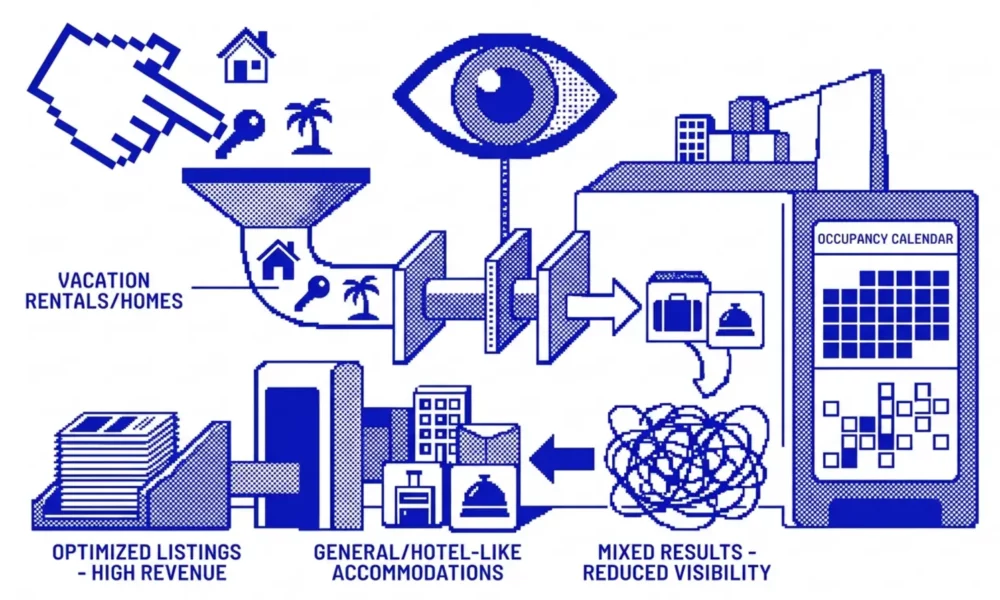
Brian Chesky, CEO of Airbnb, has articulated a significant strategic pivot for the platform, emphasizing a distinct separation between short-term rentals termed “homes” and hotels. This separation marks a departure from the mixed listings typically seen on Online Travel Agencies (OTAs) like Booking.com, which showcase various types of accommodations together. Under this new strategy, Airbnb intends to harness the power of artificial intelligence to tailor the user experience more effectively, ensuring that guests see only the listings that align with their preferences. For instance, users actively searching for hotel accommodations would predominantly receive hotel listings, while those looking for vacation rentals would be directed toward private home offerings. This shift aims to enhance the customization of search results based on individual user profiles and contextual signals.
Table Of Content
Positioning Within the Competitive Landscape
While Airbnb continues to develop its hotel offerings, this is framed as a separate initiative rather than an integrated listing model. Chesky describes this era as a movement toward becoming a “digital concierge,” expanding the scope of services beyond simple accommodation bookings. In contrast to traditional OTAs, which rely on mixed listings with category filters, Airbnb’s approach seeks to curate experiences that resonate more closely with users’ expectations. Consequently, this could lead to a diminishment of direct competition between hotels and home rentals as Airbnb refines how listings are presented, fundamentally altering competitive dynamics. However, property owners should remain cognizant that visibility will hinge on the platform’s ability to accurately interpret and match user intent, which in turn reflects on rental strategies.
Implications of AI Integration for Property Professionals
Chesky has asserted that many current applications do not leverage AI’s full potential, suggesting that Airbnb’s interface will undergo a substantial transformation from a catalog-based model to one that functions as an interactive assistant. Key aspects of this strategy include deeper personalization of search results—tailored based on factors like price range, location, property style, and amenities—and the orchestration of not only accommodation but ancillary services such as concierge offerings and activities. This integration could potentially reshape the revenue generation landscape for property management companies and rental owners, who might need to prioritize data quality regarding property descriptions, tags, and performance metrics, as these will play a crucial role in how listings are ranked.
Tensions and perspectives for professionals
The implications of Airbnb’s strategic shift are multifaceted for industry stakeholders. On one hand, properties that are unique in design and service offerings stand to benefit from the increased focus on personalization, potentially leading to higher occupancy rates and enhanced revenue per available rental (RevPAR). Conversely, properties that lack well-structured data or clear differentiation may struggle to fit within the new categorizations established by the platform’s AI algorithms, potentially resulting in reduced visibility. As the competitive landscape evolves, professionals must consider multi-channel strategies, balancing their presence on Airbnb with other platforms like Booking.com and Expedia, which maintain a catalogue-style approach to listings. The effectiveness of this new model will fundamentally depend on how well the host community and service providers adapt to Airbnb’s evolving marketplace dynamics.





No Comment! Be the first one.